[Special Exhibition]
Genta Yoshii and Tosa Papermaking
October 3, 2026 – November 29, 2026



October 3, 2026 – November 29, 2026
Genta Yoshii (1826–1908) was born into a family of official papermakers in what is now Ino Town, Kochi Prefecture. He lived through a period of great change in the papermaking industry, from the late Edo period to the Meiji era, when traditional handmade Japanese paper, or washi, increasingly coexisted with—and was challenged by—Western-style machine-made paper, or yoshi.
One of Yoshii’s first major achievements was the completion of the “Tosa large papermaking frame” in 1860. This papermaking tool enabled papermakers to produce two to three times as much paper as before, helping meet the growing demand for paper.
Yoshii also worked to develop new types of paper. Among the 28 varieties he developed were Koppī-shi, a type of paper made from gampi paper that was given a new use for copying; thin papers such as Zushashi and Shokan-yōshi; and fire-resistant paper. These papers were exhibited at the National Industrial Expositions in Japan and at international exhibitions overseas, where they received numerous awards. In particular, Yoshii improved on a type of paper originally produced in Mino, creating Tengu-jōshi, a remarkably thin yet strong paper. It came to be widely exported to Europe and the United States, where it was used, among other applications, as copying paper for typewriters. Yoshii also worked to expand markets for Tosa paper, laying the foundation for the development of the Tosa washi industry.
Yoshii also promoted the cultivation of kōzo (paper mulberry), mitsumata, and other raw materials essential to washi production. As a result, Tosa developed not only as a major papermaking region but also as a major source of raw materials for paper. For these achievements, Yoshii became known as a “benefactor of the Tosa paper industry.”
Yoshii’s activities extended far beyond Tosa. He traveled to Tokyo, Osaka, Kyoto, and other parts of Japan to provide instruction in papermaking techniques, contributing to improvements in papermaking technology and increased production throughout the country. In his later years, he compiled his knowledge and experience in Nihon Seishiron (Treatise on Japanese Papermaking), a systematic account of the techniques of washi production.
Throughout his life, Yoshii devoted himself to the modernization and development of washi.
This exhibition, held to commemorate the 200th anniversary of Yoshii’s birth, introduces his achievements and the development of the Tosa papermaking industry that followed from his work.
December 12, 2026 – February 28, 2027
Hariko is a traditional Japanese paper craft used to make figures such as dolls and masks. It is created by layering sheets of washi (Japanese paper) over a wooden mold, allowing it to dry, and then coating it with a mixture of gofun (a white pigment made from ground seashells) and nikawa (animal glue). Once this layer is dry, the figure is painted with other colors to finish.
This mini exhibition features hariko zodiac figures. We invite you to enjoy the warm texture of washi and the charmingly rounded shapes that give hariko its distinctive appeal.
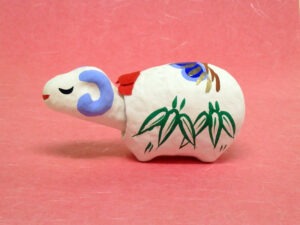
Izumo Hariko: Sheep
Made by Koichi Takahashi, Shimane Prefecture, 1991